
If you moved to Florida from anywhere else in the country, one of the first things you noticed about the houses here is what they are missing. No basement. No crawl space. The floor of your home sits on a concrete slab, and that slab sits directly on the ground.
That is not an architectural quirk. It is a response to conditions, and it changes the flooring conversation completely. Almost every flooring failure we are called out to in South Florida traces back to what is happening in the slab rather than to the flooring itself. Understanding that is the difference between a floor that lasts twenty years and one that fails in three.
The reason is the water table. Across most of South Florida, groundwater sits within a few feet of the surface, and in some coastal areas closer than that. Dig down to build a basement and you are digging into water.
Underneath that sits porous limestone, which holds and moves water rather than blocking it. Combine the two and a below grade space becomes impossible to keep dry, whatever you line it with.
So Florida builds up rather than down. A slab is poured at or slightly above ground level, and the house goes on top. It is the right solution for the conditions, and it comes with one significant consequence for everything laid on top of it.
Concrete is not waterproof. It looks solid, but it is a porous material full of microscopic capillaries, and water moves through it from wet to dry.
Your slab sits on damp ground. The air inside your air conditioned house is drier than that ground. So moisture travels upward through the concrete continuously, evaporates at the surface, and meets whatever you have installed there. This is called vapor drive, and in South Florida it never stops. It is not seasonal, it is not weather dependent, and it does not require a leak.
Two things determine how much of a problem this becomes.
Whether the slab has a vapor barrier. Modern construction places a plastic membrane between the ground and the concrete before the pour. Homes built from roughly the nineteen eighties and nineties onward generally have one. Homes from the fifties, sixties and seventies frequently do not, and those slabs pass moisture straight through.
What you install on top. Some materials do not care about moisture at all. Others fail predictably.
The symptoms are recognisable once you know what you are looking at.
Cupping and crowning in wood. Boards absorb moisture from below and swell along their edges, so each plank curls upward at the sides. Sand it flat and it comes back, because the cause is still there.
Swelling at laminate seams. Laminate has an HDF core, which is compressed wood fiber. It absorbs moisture and expands, and the joints between planks lift and peel. Once that happens, it does not go back.
Adhesive failure. Moisture arriving at the underside of a glued floor breaks down the adhesive bond. Planks or tiles work loose, first a few, then more.
Buckling and lifting with no visible cause. A floor that rises in the middle of a room with no leak anywhere is almost always dealing with vapor drive.
Mold beneath the surface. Moisture trapped between a slab and a floor covering with nowhere to escape creates exactly the conditions mold needs, out of sight.


None of this is guesswork. Slab moisture is measurable, and the assessment happens before any material is chosen.
The industry uses two standard methods. A calcium chloride test measures how much moisture emerges from the slab surface over a set period. A relative humidity probe is inserted into a hole drilled in the concrete and reads the humidity inside the slab itself, which is generally considered the more reliable of the two.
Flooring manufacturers publish maximum acceptable readings for their products. Installing above those limits is what voids a warranty, which is worth knowing before anyone tells you the slab is fine because it looks dry.
Where readings come back high, the answer is a moisture barrier system. This is a liquid applied coating rolled onto the prepared slab that cures into a membrane, blocking vapor from reaching the flooring above.
It is an added cost, and it is the cost that saves the floor. Skipping it on a slab that needs it means paying for the flooring twice.
Moisture is one part of what subfloor preparation covers. The rest is physical. Cleaning the slab down to bare concrete, patching cracks and holes, grinding high points, and leveling low areas with a compound so the whole area sits in one plane.
That matters because every flooring type transfers what is underneath it to the surface. A dip becomes a soft spot underfoot in vinyl plank. An uneven area under tile means cracked tiles and loose grout within a year.
Tile is completely unaffected by moisture. It does not swell, warp or absorb, and it has no organic content for mold to feed on. It is why tile has been the Florida standard for generations, and why it is still the answer for kitchens, bathrooms and entryways in any house of any age. Its one requirement is a flat, stable slab, because tile does not flex.
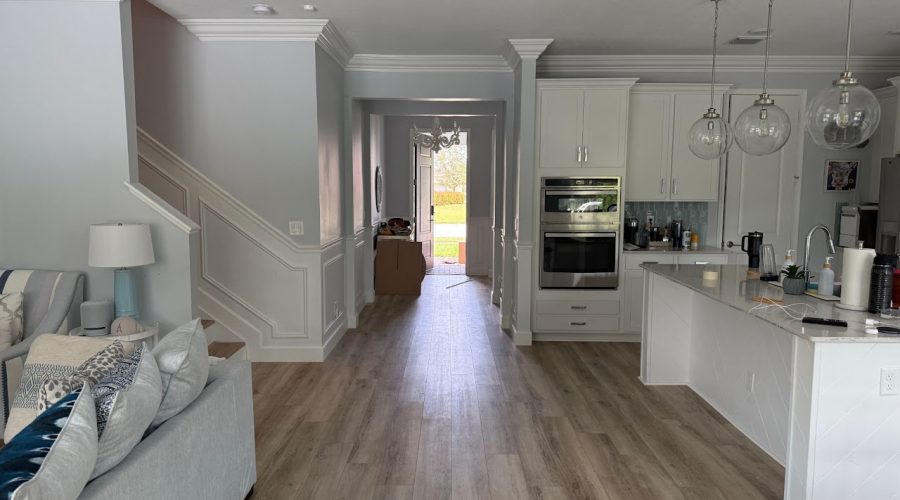
Vinyl plank contains no natural wood. There is nothing in it for moisture to swell, which is why it has become the most installed floor in South Florida. It handles slab conditions that would destroy laminate, gives the appearance of wood, and individual planks can be replaced if one is damaged.
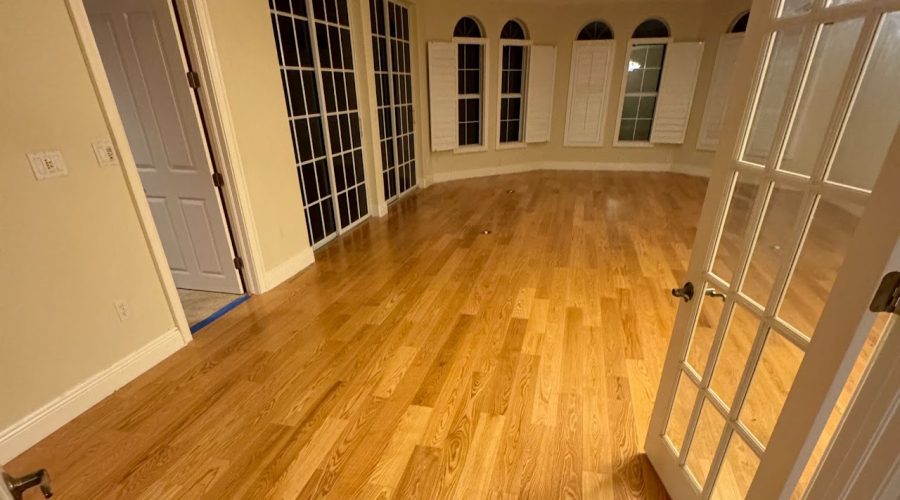
Engineered hardwood is a real wood veneer over a plywood core, and that layered construction is far more dimensionally stable than solid timber. It expands and contracts less as humidity changes, which makes it the version of hardwood that works over a slab here. Solid hardwood over a Florida slab is a gamble even with mitigation in place.
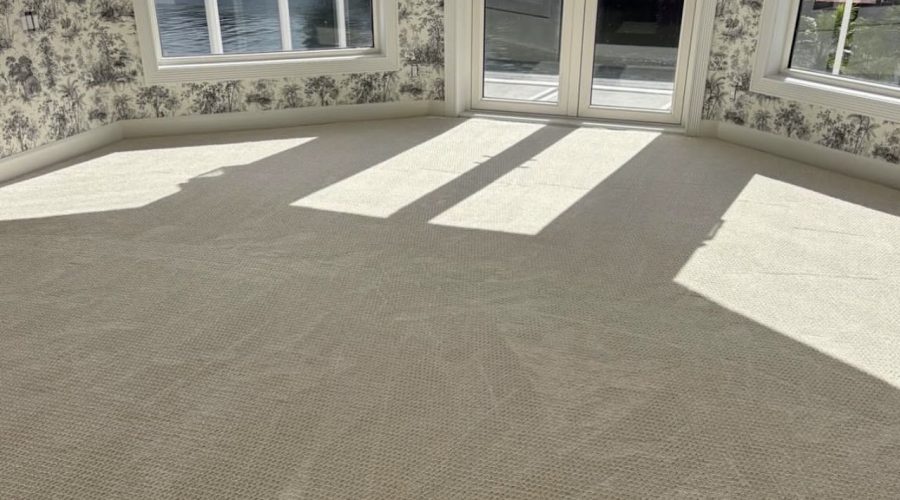
Carpet itself is unaffected by vapor drive, but the pad underneath and the adhesives can be. On a slab with high readings, moisture trapped beneath carpet creates ideal conditions for mold. With proper assessment and preparation it works well in bedrooms and living areas.
Laminate is a good floor at a good price, but its HDF core is wood based, which makes it the most vulnerable option on this list. Over a slab with a functioning vapor barrier and correct underlayment it performs well. Over an older Florida slab without one, it is the material most likely to fail.
The honest answer is that you cannot know by looking. But the decade the house was built gives a strong indication.
Built before roughly 1980. Assume there is no effective vapor barrier until testing proves otherwise. This covers a large share of Hialeah, Little Havana, Coral Gables, Hollywood, Plantation, Fort Lauderdale and the older parts of Delray and West Palm Beach.
Built 1980 to 1995. Variable. Practice was changing through this period and it depends on the builder. Testing is worth doing.
Built after 1995. A vapor barrier is very likely present. This covers most of Doral, Weston, Pembroke Pines, western Miramar, Heron Bay and the newer communities across all three counties.
Age indicates likelihood. Testing establishes fact. A barrier can be damaged during construction, and slabs poured with one still produce high readings sometimes.
Before you install anything, walk the space and look for these.
White powdery deposits on the bare slab. That is efflorescence, mineral salts left behind by water evaporating out of the concrete. It is direct evidence of moisture movement.
Dark patches in the concrete that never seem to dry out.
A musty smell when you lift a corner of existing carpet or vinyl.
The previous floor failed and nobody could explain why. That is the clearest signal of all.
Yes. Vapor drive is invisible. A slab can read well above manufacturer limits while feeling perfectly dry to the touch, because the moisture is evaporating as fast as it arrives. Feeling the surface tells you nothing useful.
An underlayment with a vapor retarder helps, but it is not the same as a liquid applied mitigation system on a slab with high readings. Which one is appropriate depends on the test results and on the flooring being installed.
That is the classic presentation of slab moisture. Relaying the same floor without addressing the cause produces the same result. What has to change is the material choice, the preparation, or both.
It is done, with full mitigation and the right installation method, but it carries real risk over a slab in this climate. Engineered hardwood gives you a genuine wood surface with far more stability, which is why it is what most Florida homeowners end up choosing.
Through testing, as part of the subfloor assessment before installation. We inspect and prepare the slab on every project, and we tell you what we find before any material goes down.
The single most expensive mistake in Florida flooring is installing over a slab nobody assessed. The flooring gets blamed, but the flooring was never the problem.
Our team handles the whole sequence, removal of your existing floor, inspection and preparation of the slab, installation, and baseboards, across South Florida.
Call (786) 720-7328 or request your free estimate and we will tell you what your slab actually needs.
Call us or send a quick request online.
We measure on site and help you choose.
Our licensed team installs your new floor.
We check every detail together before we leave.
Our skilled team has years of experience in residential and commercial flooring projects.
We use top-grade products for long-lasting beauty, strength, and durability.
From start to finish, we deliver timely, clear, and dependable service every time.